
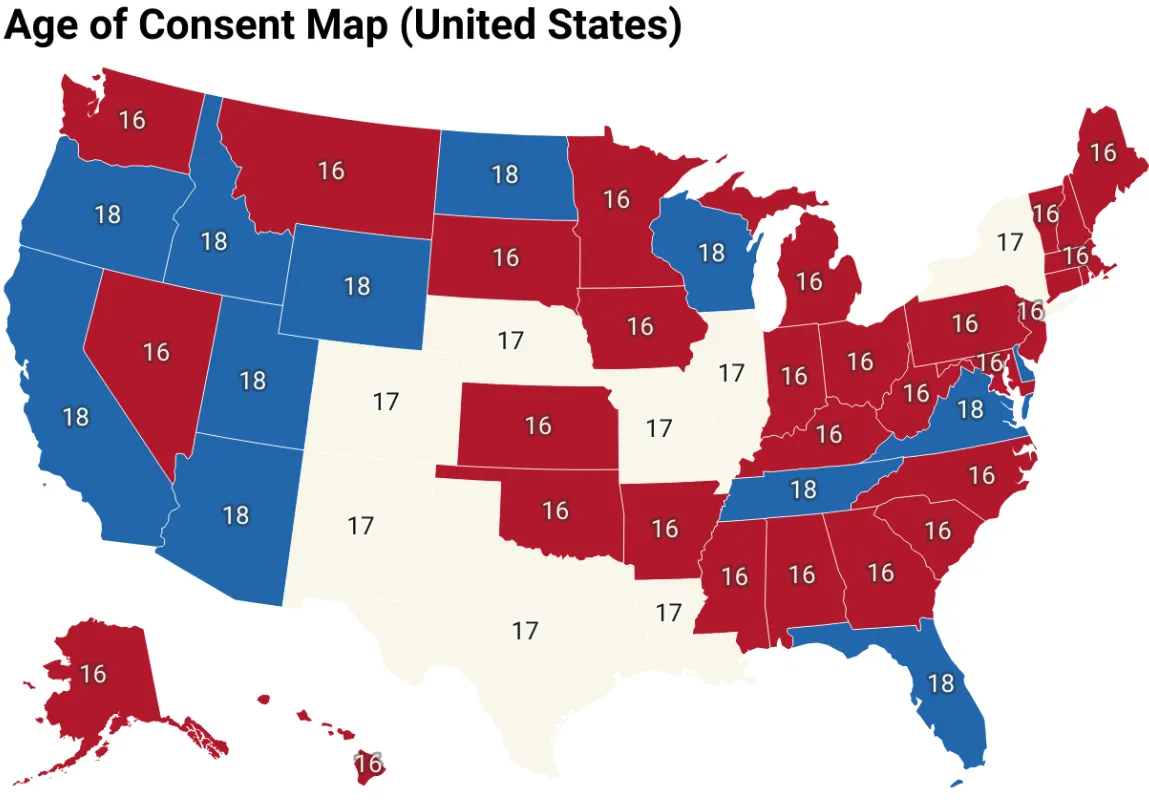
The age of consent sounds straightforward until you start looking at California law. Parents worry about their teenagers dating. Young adults wonder if they’re breaking the law. Anyone facing charges needs to understand exactly what the statute says.
Here’s the basic answer: The age of consent in California is 18 years old.
But that number doesn’t tell the whole story. California’s approach includes several tiers of charges based on the ages involved.
What California Law Actually Says
California Penal Code Section 261.5 makes it illegal to have sexual intercourse with anyone under 18 years old. The law calls this “unlawful sexual intercourse” or statutory rape.
Consent doesn’t matter under this law.
Even if both people wanted to engage in sexual activity, the law considers anyone under 18 unable to legally consent. The younger person can’t be charged, but the older person can face serious penalties.
Who Gets Charged?
The statute applies to sexual intercourse specifically. It’s “gender-neutral,” covering:
- Males having sex with females
- Females having sex with males
- Same-sex encounters
The law focuses on age, not gender.
How Penalties Break Down by Age Difference
California uses a tiered system. The age gap between the two people determines charge severity.
- Age Difference of Three Years or Less
Charged as a misdemeanor under PC 261.5(b).
Examples:
- An 18-year-old and a 17-year-old
- A 19-year-old and a 16-year-old
Maximum penalties:
- Up to one year in county jail
- A fine up to $1,000
- Age Gap Exceeds Three Years
The charge becomes a “wobbler” under PC 261.5(c).
Prosecutors can charge it as either a misdemeanor or a felony based on:
- The defendant’s criminal history
- The specific circumstances
- The minor’s age
If charged as a misdemeanor:
- Up to one year in county jail
If charged as a felony:
- 16 months, two years, or three years in state prison
- Adult Over 21 with Minor Under 16
The most serious tier under PC 261.5(d).
Also a wobbler offense with enhanced penalties.
If charged as a felony:
- Two, three, or four years in state prison
A 25-year-old having sex with a 15-year-old faces these enhanced penalties.
How About Civil Penalties?
Beyond criminal charges, California allows civil fines:
- Less than two years age difference: up to $2,000
- At least two years: up to $5,000
- At least three years: up to $10,000
- Adult over 21 with minor under 16: up to $25,000
Common Misconceptions
A lot of people misunderstand how California’s age of consent law works. These myths can lead to serious legal trouble.
“Both People Were Teenagers, So It’s Legal”
Wrong. If one person is 18 or older and the other is under 18, charges can be filed. A 19-year-old high school senior dating a 17-year-old junior? Technically illegal.
“We’re in a Relationship, So It’s Different”
Dating doesn’t provide legal protection. Marriage creates an exception, but relationships don’t.
“The Minor’s Parents Gave Permission”
Parental consent doesn’t make it legal. Parents can’t waive statutory rape laws.
“It Was Just One Time”
Frequency doesn’t matter. A single instance violates the law.
Does California Have a Romeo and Juliet Law?
No, California does not have a Romeo and Juliet law.
The closest thing is the tiered penalty system. When both parties are close in age, penalties are less severe. But the conduct is still illegal.
This means an 18-year-old can be prosecuted for having sex with a 17-year-old.
Sex Offender Registration
One of the most serious long-term consequences is sex offender registration under Penal Code Section 290.
When Registration Is Required
You’ll likely have to register if:
- Convicted of a felony violation
- The judge orders registration as a condition of probation
- The case involved aggravating factors
What Registration Means
- Registering with local law enforcement where you live
- Updating annually on your birthday
- Updating within five days of moving
- Having your information published on Megan’s Law website
This follows you for life and affects where you can live and work.
Defenses to Statutory Rape Charges
If you’re facing charges under PC 261.5, several defenses might apply depending on the facts of your case.
- Mistake of Age
California allows a defense based on a reasonable mistake of the minor’s age. If you reasonably believed the person was 18 or older, this can be valid.
Factors courts consider:
- How the minor looked
- What they told you about their age
- Whether you met at an age-restricted venue
- Any fake ID presented
- False Accusations
Unfortunately, false accusations happen due to:
- Angry parents
- A minor trying to avoid punishment
- Custody disputes
- Revenge after a relationship ends
- No Sexual Intercourse Occurred
Prosecutors must prove intercourse happened. If it didn’t, the charge won’t stand.
- Statute of Limitations
California has time limits:
- Misdemeanor charges: generally one year
- Felony charges: generally three years
What Happens If You’re Charged
Facing statutory rape charges is serious and the stakes are high. Understanding the legal process can help you know what to expect at each stage.
Investigation Phase
Law enforcement may:
- Interview the alleged victim and witnesses
- Collect evidence
- Request phone records or social media messages
You have the right to remain silent. Use it.
Court Process
- Arraignment – First court appearance where charges are read
- Pre-Trial – Your attorney reviews evidence and negotiates
- Trial (if necessary) – Prosecution presents their case, your attorney presents your defense
Why Legal Representation Matters
Statutory rape charges carry life-altering consequences. You need an attorney who understands:
- California’s complex age of consent laws
- How to challenge the prosecution’s evidence
- Which defenses apply to your situation
- How to negotiate favorable outcomes
The Nieves Law Firm handles cases throughout California. They can evaluate your situation, explain your options, and build a defense strategy aimed at protecting your future.
The Bottom Line
California sets the age of consent at 18. Having sexual intercourse with anyone younger violates the law, regardless of consent. The penalties depend on the ages involved, but all violations carry serious consequences.
If you’re facing charges or worried about a situation involving minors, talking with an attorney who knows California law is the best step.